
On Distant Stations is a recurring feature devoted to obscure bands and artists—particularly those who never recorded a full-length album. In it, we explore the stories and songs behind some of pop music’s most intriguing ‘could have been’ cases.
**This piece was originally published on February 16, 2020, but has been updated to reflect recent findings.**
Last week I received an email from Discogs, notifying me that an item on my wantlist was for sale. I immediately knew what it was, as there’s currently only one record on that list. Though I’ve had a vinyl collection for as long as I can remember, I’ve only been seriously collecting for about a year. In that time, I’ve picked up many of my favorite albums, some as reissues, and many in early—or even first—pressings. Since I’m still relatively new to the active pursuit of records, I’ve mostly taken a ‘get it as I find it’ approach to collecting—content to pick up albums as I find them in the (many) great record shops in the Portland metro area. Therefore, my Discogs wantlist remains nearly nonexistent.
The lone exception is a 2002 compilation by a Southern California garage band from the mid-sixties called The Dovers. We’re Not Just Anybody collects the eight songs that the group recorded from 1965-1966 and released as singles on the tiny Miramar Records label. Unlike those original singles, We’re Not Just Anybody isn’t an exceedingly rare item; it’s just that when copies get listed on Discogs, it’s usually by a European seller, meaning that there will be a $20+ shipping cost on top of a $40-50 record. Last week’s notification was from an American seller, but by the time I was able to act, someone else had jumped on it first. Therefore, I continue to wait.
Fans of sixties garage bands tend to be familiar with The Dovers. Several of their tracks have landed on garage compilations, such as the Pebbles series. Their best-known song, “What Am I Going To Do,” appeared on the expanded 1998 box set version of the beloved 1972 Nuggets compilation. Nestled among scuzzy Stones knock-offs and nascent punk sides, “What Am I Going To Do” is a breath of fresh air—practically ethereal in comparison to what surrounds it. Led by a simple 12-string guitar riff, and punctuated by an organ embellishment, it is easily one of the most appealing songs on a truly indispensable set.
And as any fan of Nuggets knows, digging deeper into the catalogs of the featured bands is a fascinating, often-rewarding, sometimes frustrating, and potentially expensive hobby. The compilers at Rhino generally did an admirable job of highlighting the best work from each group, and—more often than not—further exploration can quickly lead to diminishing returns. Even still, the uniquely atmospheric sound of “What Am I Going To Do” makes The Dovers a particularly intriguing candidate for a deeper look.
The band that would eventually become The Dovers began in the early sixties as The Vandells, with Santa Barbara teens Bruce Clawson (guitar), Tony “Goosey” Rivas (saxophone), and Rick Morinini (drums) playing instrumentals at parties and school dances. By 1964, the band—now known as The Del Mars—had been joined by Carpinteria local Tim Granada (vocals, rhythm guitar) and Robbie Ladewig (bass), the latter of whom convinced a friend, Tony Cary, to act as the group’s manager/producer. It was Cary who chose the name The Dovers, suggesting that its “British” sound would play well in the wake of the British Invasion.
The Dovers became a recording act in the summer of 1965, booking a session at the famed Gold Star Studios, where Phil Spector and Brian Wilson—among many others—had produced some of the most successful singles of the era. Among the songs that they recorded in that first session were the pair that would be released as their first single: “She’s Gone” and “What Am I Going To Do.” That single would be issued on Tony Cary’s Miramar Records in September 1965.
Anchored by the steady drumming of Morinini—who was still in high school at the time—”She’s Gone” has a decidedly surfy sound. Written by Clawson, the track takes advantage of Gold Star’s legendary echo chambers, creating a spaciously dark atmosphere that stood in stark contrast to the dry sound of most garage rock circa 1965. Thanks to some help from Cary’s connections to local radio deejays, “She’s Gone” became something of a minor regional hit in the Los Angeles area.
While it was “She’s Gone” that gained The Dovers exposure on local radio, it’s the song’s B-side that remains the group’s most endearing track. Clawson’s 12-string riff forms the backbone of “What Am I Going To Do,” but it’s Tim Granada’s lead vocals and Tony Rivas’ high harmonies that truly elevate the song into the pantheon of sixties garage classics. Few tracks of the decade are so plaintively innocent; and almost none are so perfect.
Late 1965 saw the release of The Dovers’ second single, “I Could Be Happy” b/w “People Ask Me Why.” The A-side is my runner-up favorite Dovers track, again highlighted by Clawson’s 12-string guitar and Granada and Rivas’ harmonized vocals. While it’s tempting to call it Byrds-ian, it’s worth noting that The Byrds had only just released their first album a few months prior, and that both bands had effectively grown out of the same Los Angeles-area scene.
The B-side, “People Ask Me Why,” was the most downbeat song in The Dovers’ catalog to date. The 12-string again dominates this moody track, and while it doesn’t stand amongst their very best work, “People Ask Me Why” shows that even the band’s B-material had considerable depth.
While the group’s second single was initially released on Miramar in November 1965, it was picked up by Reprise Records the following month. Though the chance at wider distribution seemed to provide the potential for The Dovers’ breakthrough, success proved to be elusive, and the band was beginning to fall apart.
Early 1966 saw The Dovers undergoing a significant lineup change, as both Rivas and Morinini left the group. The other members and Tony Cary had begun using LSD, and a rift developed within the band. This division was also reflected in their new music. In fact, it was during an LSD trip that Bruce Clawson began writing what would become the A-side to the group’s third single.
Released in April 1966—exclusively on Miramar, as Reprise had apparently lost interest—”The Third Eye” represented a new sound for The Dovers. Inspired by Ravi Shankar, the song is easily the most psychedelic entry in the band’s catalog. While both The Kinks (“See My Friends”) and The Beatles (“Norwegian Wood”) had already dabbled with Indian raga sounds in 1965, “The Third Eye” managed to incorporate that influence into a heavy rock track, with Clawson’s manic guitar phrases and crashing drums, courtesy of new member Randy Busby. Its closest comparison is The Byrds’ classic, “Eight Miles High,” which was, incidentally, released just weeks prior.
B-side, “Your Love,” was nowhere near as far out as “The Third Eye.” More reminiscent of the band’s 1965 tracks, it’s another simple pop song that features Clawson’s jangly 12-string Rickenbacker. As was the case with “People Ask Me Why,” it provides proof that The Dovers certainly could have compiled a full album worth of strong tunes, without resorting to filler and/or by-the-numbers readings of rock-and-roll classics, as so many of their garage contemporaries did when presented with the opportunity to record a full-length LP.
The final single released by The Dovers was led by “She’s Not Just Anybody.” Written by Tim Granada, the track is one of the band’s best. Bruce Clawson’s jangly 12-string lead and Robbie Ladewig’s fuzz bass make for a perfectly-complementary pairing, and the crashing instrumental break is arguably the most exciting moment in their small catalog.
B-side, “About Me,” is one of the group’s low-key moments, but it’s another effective track that features Clawson’s ringing harmonic guitar work, and Granada’s signature quavering vocals.
By mid-1966, The Dovers had lost almost all of their momentum. Robbie Ladewig and Tony Cary had turned to harder drugs, and rehearsals became less productive. Bruce Clawson—whose guitar work had provided the jangly charm to the band’s songs—was kicked out of the group that summer, replaced by Nick Hoffman, who would stay with the group during its final dwindling months. No record of The Dovers exists beyond 1966, and the band’s members would remain completely anonymous—at least in the music world.
The Dovers would eventually earn a second life as their songs began appearing on garage rock compilations in the seventies and eighties, but it was their appearance on the expanded Nuggets in 1998 that grew their legend the most. “What Am I Going To Do” became a mixtape/playlist favorite among garage aficionados, and revived interest in the band’s music led the small Italian label Misty Lane Records to issue their entire catalog as We’re Not Just Anybody in 2002.
This increased exposure would lead to—and expand as a result of—a tribute of a different sort. In 2009, Bradford Cox’s Atlas Sound project released its second LP, Logos. The album’s first single, “Walkabout,” was built around a sample of “What Am I Going To Do”—its dreamy Rickenbacker/Wurlitzer riffs providing the sublime backing to a beautiful song that is simultaneously nostalgic and futuristic.
Despite their eventual cult success, the story of The Dovers remains virtually unknown to even those familiar with their music. Like countless other short-lived garage bands of their day, the members of the group went on with their lives, presumably away from music. Precious few scraps of their biography exist online, but the songs live on regardless.
Listening to the band’s entire recorded output takes less than twenty minutes. All eight of their songs are excellent, and no fewer than five are legitimately great. At least one of them—”What Am I Going To Do”—is an all-timer. And while I’d strongly recommend that you give this mostly-forgotten group of California teenagers a chance, just don’t grab the next available copy of We’re Not Just Anybody before I get to it.
**POSTSCRIPT (February 1, 2026)**
Prompted by both a positive response and informative comments from readers, I’ve decided to update this piece, nearly six years after it was originally published. Not only is it one of the most frequently-visited posts on Strange Currencies, but it remains one of the few informative pieces out there on a truly special garage band.
First off, I secured a copy of We’re Not Just Anybody not long after publishing this article. While the record collection that I described in meager terms above has grown exponentially over the past six years, that eight-song slab of 10″ vinyl remains one of the most treasured items in my library. This afternoon, on a tip from reader Robert, I ordered the recent 12″ reissue—not to replace the original, but to augment it.
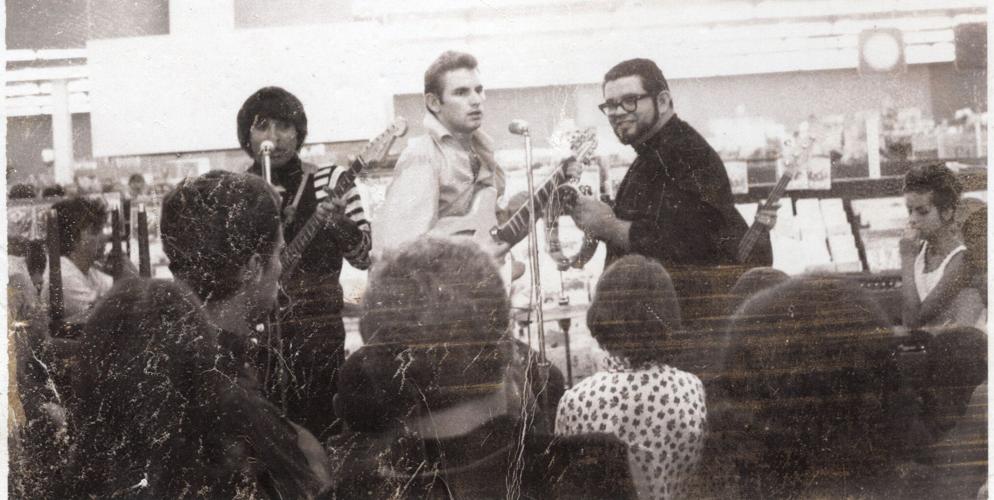
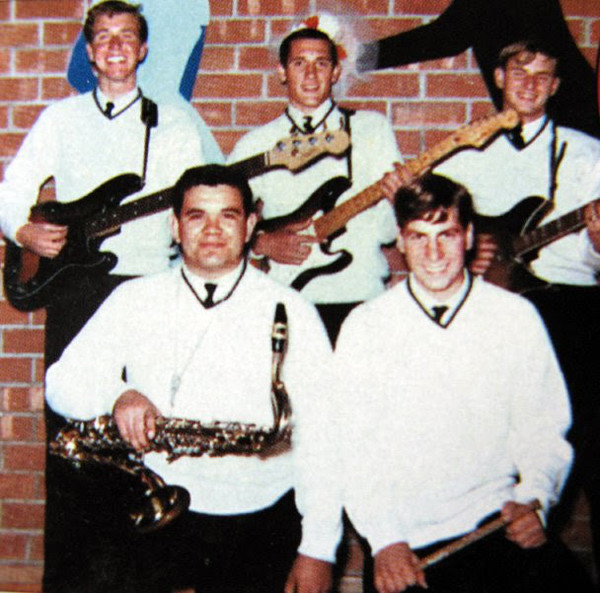
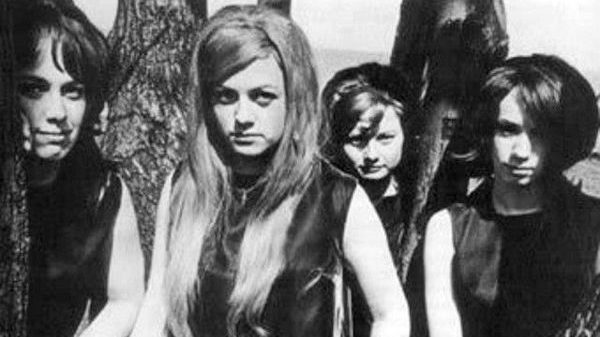
I also recently received a comment from Tami Granada—presumably a relative of Tim—informing me that my caption for the original header image was incorrect. Apparently, that picture—which has frequently been cited as the only actual image of The Dovers—was actually of a pre-Tim Granada lineup of The Vandells. In doing some additional research, I discovered that more images of the band have surfaced since I first published this piece. This article from a Carpinteria, California webpage contained several ‘new’ photos, and this piece—originally featured in Carpinteria High School’s student publication—also shed new light on this most elusive group.
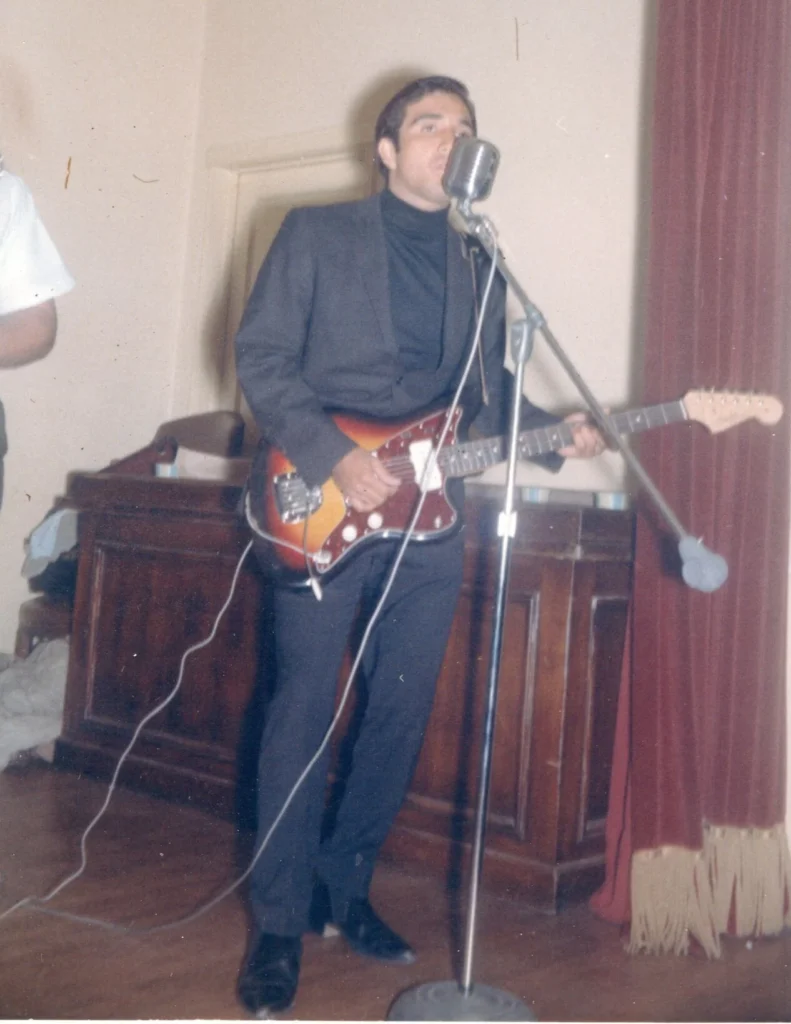
I was particularly struck by two of the recently-surfaced photographs. The first is the new header image for this article: a fascinating shot of THE ACTUAL DOVERS PERFORMING(!!!) at the Disco Fair in Goleta, California. The front line of Tim Granada, Bruce Clawson, and Tony Rivas is beautifully framed by a group of onlookers, witnessing a moment that thousands of present-day garage rock collectors would have killed to see and hear. The second of these is a photo of Granada fronting the band—then known as The Del Mars. While the aforementioned garage enthusiasts would be excited to view any previously-unseen image of the group, I was uniquely thrilled to see Granada playing a sunburst Fender Jazzmaster with a tortoise shell pickguard. I have the exact same guitar—albeit in a Japanese reissue, designed to match the exact specifications of the early-sixties American model that Granada owned.
Lastly, I wanted to share an anecdote that I alluded to in a reply to a reader, but that I felt deserved a spot in the article proper. Two years ago, I began offering a Music History course at the high school that I teach at. Covering the history of pop music from the Delta Blues to Hardcore Punk in a semester-long class is a bit of a whirlwind, but I make a point to devote a full block period to American garage rock—beginning of course with local-to-us Pacific Northwest heroes like The Wailers, The Kingsmen, and The Sonics.
Toward the end of the day’s program, I turn to my copy of We’re Not Just Anybody, to play that otherworldly little gem that was relegated to the B-side of the first single by quintet of kids from a pair of coastal towns in Southern California—a single that most recently sold on Discogs for the princely sum of $2,700, and which I now have on the wantlist that I framed this original article around. For the class, I have students fill out a listening journal, and here are just a few of the comments on the song from the most recent semester’s group. I’ve left them unedited—I don’t grade these on spelling, grammar, punctuation—for authenticity’s sake:
“I love this song so much, they sample it from another song that I really like called walkabout”
“This is the first time ive ever heard this song, its definitely my favorite one we have listened to so far.”
“It’s like a heartbreak song and it sounds like he has a heavy heart”
“It’s a breakup song, but instead of scorning the woman or declaring hatred, it’s a yearning sound that tells the subject that they’re going to miss and need the woman for the rest of the speaker’s life. That’s really sweet, and makes you feel really bad for the singer.”
“This song makes me feel nostalgic and slightly emotional. It creates a soft, dreamy atmosphere that stands out from heavier rock. It reminds me of feeling uncertain or heartbroken.”
“I really liked the chord progression. I feel like it carried a lot of emotion. AND I LOVE HIS VOCALS I JUST LOVE THE WAY HIS VOICE SOUNDS.”
“I LOOOVED this song!! It was so happy sounding and just dreamy and a little psychedelic, I´ll definitely be listening to it again and definitely looking for that rare record.”
“Overall great song that I will be listening to again, it´s very unique to me”
“I like how honest the vocals sound. The experience that’s being described and the musicality of the song feel very vulnerable, which can make the song feel more relatable.”
“It feels like surrender. Even the title”
“This song is great. It sounds like you’re in a dream while it’s being played. I heavily love the guitar and drums in this song. This song has vocals very similar to the beach boys but this melody sounds really unique to me.”
“It makes me think of not worrying about things, and maybe childhood memories”
“The instrumentation was my favorite part of this song. It is so unique, it has this really dreamy, floating on clouds type of sound, but it still has that really amateur/ homemade sound to it, which is really awesome to me.”
“This song made me very sad, but I still liked it a lot. All the aspects of this song have a really depressing sound to them. The lyrics made me especially sad. That feeling of wondering what you are missing, and why you aren’t receiving the love you give out. It is such a sad set of lyrics, but I feel like everyone can relate to it, not just in relationship terms, but in all things. Everyone has felt like they weren’t enough at one time or another. The instrumentation compounds that depressing feeling of the lyrics, the keyboard gives the instrumentation a very cold sound. The instrumentation and the song in general really reminds me of a really drab winter day, like after a snow day when all the snow is melting, and your snowman is slowly but surely shrinking. The vocal performance is just the cherry on top. The singer reminds me so much of the Beatles. He has a sort of nasally voice, and it works so well on this song. All the aspects of this song are so amazing in such a sad way, and I love it even though it makes me frown.”
“I liked this song a lot I really wish it was on spotify!!!”

What a gift. Thanks for sharing. “She’s not just anybody” … that instrumental is…. just choice.
Copies of the Dovers 10” mini LP can be ordered at http://www.mistylaneshop.com or directly via mail: mistylane.records@gmail.com
Nice. But you don’t inform on who wrote ‘your love’
This is such a fantastic article, I am truly so thankful for this glowing review and it warms my heart to see people truly loving his music. Just FYI though Tim Granada is NOT in that photo above. Not sure who that is, but it is definitely NOT Tim.
Thank you for the comment. It’s so tough to find reliable information about these 60s-era garage bands, but that’s part of what makes them so fascinating. Either way, The Dovers are just about as good as it gets from the garage bands. Glad you found the article!
Hi Tami. I have updated the caption of the photo (apparently The Vandells, prior to Tim joining the band) to reflect your info. Since I wrote this article in 2020, a few pictures of Tim and The Dovers have surfaced. I’m adding those to this piece. Please let me know if they are inaccurate, and I’d love to hear any more info about Tim and The Dovers.
Greetings from Nashville. Kudos for taking your time to research and compose an article create about The Dovers. I’m sure it has served to create a greater awareness of one of the great obscure groups of the mid-sixties. I originally read this about five years ago. I’m happy to see a Granada family member contribute as well. Perhaps Tami can contribute more important history to document.
Anyway, I wanted to mention that Misty Lane Records (in Italy) have remastered ‘We’re Just Not Anybody’ as of August 2025. It has been scaled up from the original 10″ pressing to a 12″ disc. Unlike the original 10″ versions of 500 copies, this one is limited to 150 copies. The link posted above (in 2022) will still get you there to find it.
Thanks for the heads up, Robert! Shortly after writing this article, I was able to get a copy via Discogs, but it looks like people have good things to say about the 12″ remaster. Gonna have to pick it up.
I too appreciated Tami’s comment, and have since updated the caption in the photo to reflect her correction.
On another note, I teach a Music History course at the high school I work at, and we spend a day listening to sixties garage rock. My students have absolutely LOVED “What Am I Going To Do,” and are always frustrated to find that it is the ONLY song we cover in class that they can’t hear on Spotify/Apple Music. While I don’t exactly love those platforms, it would be great to see the whole Dovers catalog on them, as there’s definitely an audience out there for it.