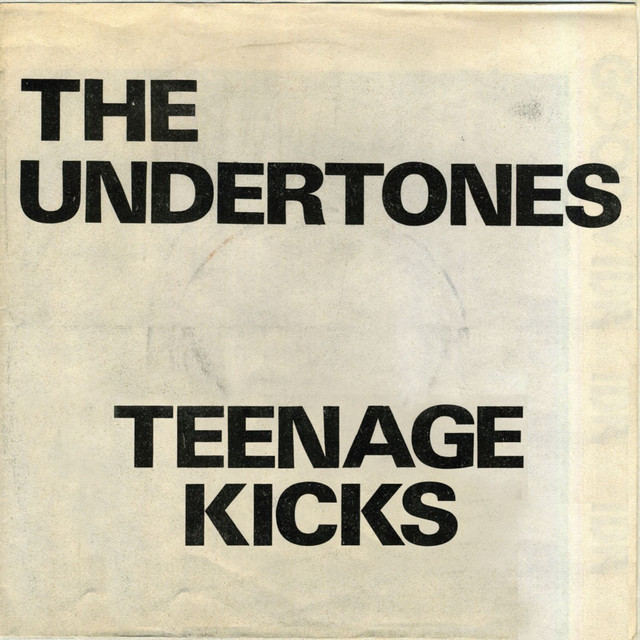
The Undertones
Teenage Kicks [EP]
Good Vibrations – 1978
Rating: 9.0
The debut release from the Derry-based Undertones stands as a defining document of a Northern Irish punk scene that emerged within a simmering cauldron of religious tensions and politically-motivated violence; and yet, its lead single is nothing more than the purest distillation of teenaged longing ever committed to magnetic tape.
Ever since I became a ‘serious’ vinyl collector during the early stages of the pandemic, my ensuing travels have all been defined to varying extents by the pursuit of records. And while, to some, this may seem counterintuitive—after all, I spend the vast majority of my time in what may be the best record shopping city in the world—this development has only served to greatly enhance my travel experiences.
To those who have asked—including my wife and kids, who have generally been patient with my many excursions—I’ve argued that record hunting has become a way to get acquainted with a city on a more meaningful level than the typical tourist activities. First off, record stores—at least the best ones—are usually found outside of the most obviously manicured parts of cities. Finding them requires walking through sometimes-sketchy neighborhoods, down alleyways, and into half-hidden basement shops. They require using public transit.
And finding these shops often requires talking to people. And in those shops, I often find my kind of people: the ones who, when hearing that I’m visiting from Portland, enthusiastically bring up Wipers, Elliott Smith, and Dead Moon; ones who are familiar with the tireless work of Mississippi Records; ones who are just as excited to hear me inquire about their own local heroes.
And in Belfast, there is no bigger hero on the local musical landscape than Terri Hooley, whose Good Vibrations label, and the Harp Bar scene that surrounded it, were a beacon to Northern Irish youth growing up during the height of the quaintly-named “Troubles.” In the Harp Bar, and at Hooley’s Good Vibrations record shop, young Catholics and Protestants could congregate, while temporarily forgetting the world’s outside noise, and bonding over what really mattered to them.
And in my own recent experiences of traveling, these shops have provided a similar kind of meeting place, where outside contexts melt away while discussing what really matters. When I’m in a record shop in another country, I’ve never felt the urge to tacitly apologize for being from a country that seems perpetually hellbent on finding new and horrifying ways of disappointing the rest of the world. I feel that urge in restaurants, museums, and on public transit. But in a good record shop, those impulses take a back seat. And every once in awhile, I find a gem in these shops: a token that commemorates a subway trip, a scenic walk, and/or a positive personal interaction.
I brought up Belfast, because a few days ago, I returned home from a two-week trip to England, Ireland, Northern Ireland, and Spain. In all of these countries—only one (England) of which I had previously visited—searching for records was near the top of my list of priorities. This was particularly true in Northern Ireland, as I’ve recently become fascinated by the punk scene that emerged in and around Belfast during the late-seventies.
While in Belfast, I began my record hunt at a vintage shop with only a small collection of used vinyl. I had actually been advised to start there by an employee at a Dublin shop, who—upon hearing that I was looking for Northern Irish punk—asserted that Young Savage might be the place to find “that kind of craic.” Though I came up empty-handed, the proprietor happily pointed me in the direction of an actual music shop, Hectic Records.
The young employee working the counter at Hectic said that although I was in the right part of the world to find the kind of records that I was looking for, he rarely saw them come into his shop; and that when they did, they tended to leave almost as quickly as they arrived. However, he made a call to another local store, Voodoo Soup, who confirmed that they did in fact have some local singles from the late-seventies, including a few that had been released on Good Vibrations. He drew me a map to this third shop, and enthusiastically walked me partway toward a shortcut (through a local mall) that he assured would get me to Voodoo Soup before closing time. He and I were both so preoccupied with my chase, that we left his hand-drawn map on the counter back at Hectic.
A ten minute walk brought me to the doorstep of Voodoo Soup, where three men twenty years my senior asked if I was the “Good Vibrations guy.” I affirmed, and was led inside by one of them. The shop had in its inventory several seven-inch records that had once belonged to Stiff Little Fingers’ guitarist Henry Cluney. And it was out of a small box marked “GOOD VIBRATIONS”—in typically punk-esque Sharpie handwriting—that the man who I assumed to be the owner of the shop pulled out an original (literal first pressing), Cluney-owned copy of THE Good Vibrations record.
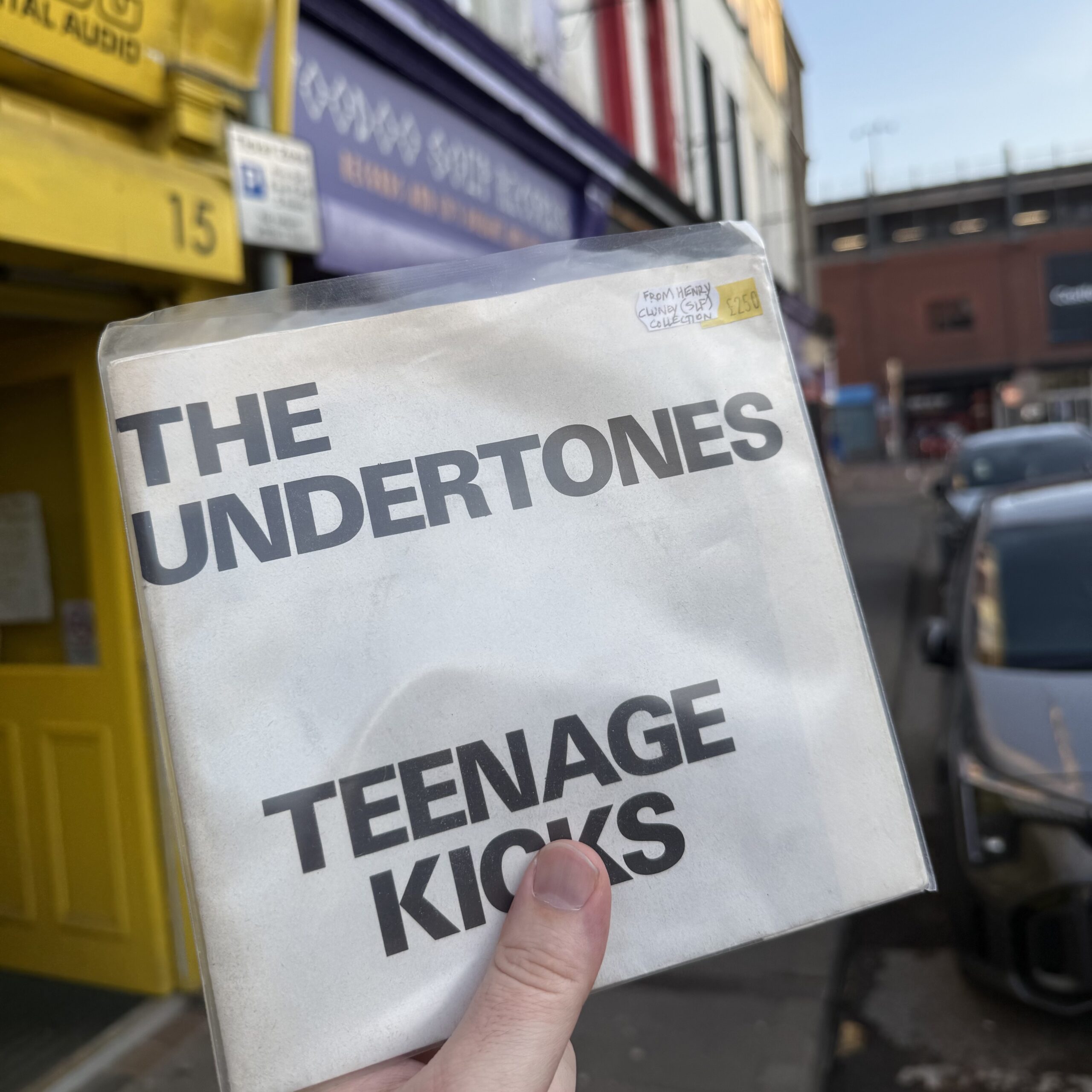
Catalog number GOT4 was the debut release from a Derry quintet called The Undertones: a four-song EP whose wraparound paper sleeves were hand-folded by Terri Hooley himself. It came out on the heels of singles by the Belfast bands Rudi, Victim, and The Outcasts, and was released with only modest expectations. In time, its lead track would famously become the all-time favorite song of legendary BBC deejay John Peel—whose headstone would be inscribed with the song’s opening lyrics—and referred to by some as the “national anthem of Northern Ireland.”
The disc wasn’t cheap, to the point of which I initially had serious reservations about buying it. That hesitation only lasted for a matter of seconds though—basically until I held the paper sleeve in my own hands. It would become the most expensive single-disc record purchase that I’ve ever made (though I got it for £50 less than the sticker price in the picture below); but given its condition, its provenance, and the sales history on Discogs, I could easily sell it for twice what I paid.
But I would never do that, even if it wasn’t a memento of an amazing trip. Over the course of those fourteen days, I spent time in London, Dublin, and Madrid. I was given a walking tour of the campus of Oxford University by my own daughter, who is a student there. I visited my family’s ancestral homeland for the first time. I saw Guernica, Las Meninas, and Goya’s Black Paintings with my own eyes.
And for two hours in the middle of that trip, I went on a wild goose chase—aided by four friendly Irish strangers—and found the ultimate souvenir. Forty-five hundred miles from home, I felt at home; and somehow, a song that I’ve adored since the first time I ever heard it became even more special to me.